Maintenance and Manufacturing Requirements for Rollers
When it comes to roller maintenance, the first step is to regularly remove dust and other foreign matter from the rollers. You should also regularly check that the welded joints on the roller end caps are secure. Furthermore, during maintenance, attention must be paid to the smoothness of the roller surface to minimise wear and tear. During operation, overloading must be avoided to extend the service life of the rollers.
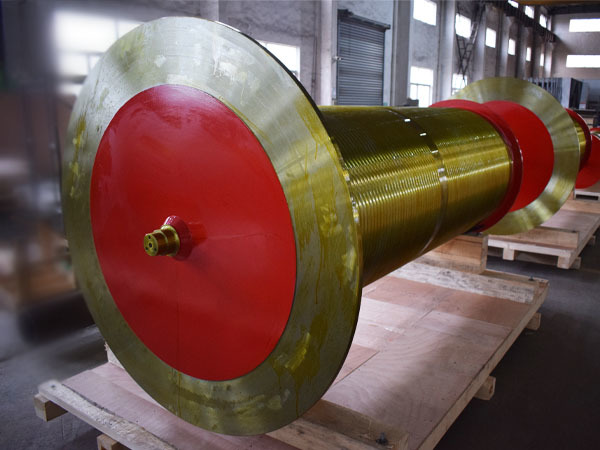
Rolls must be manufactured with sufficient rigidity to ensure that bending deformation does not exceed permissible limits under heavy loads. The surface of the rolls must exhibit satisfactory hardness; generally, a hardness of HRC 50 or higher is required, along with strong corrosion resistance. The coating must be resistant to flaking, ensuring that the working surface of the roll possesses good wear resistance and corrosion resistance.
Subsequently, attention must be paid to the appropriate finishing and precision machining of the working surface of the roll to ensure dimensional accuracy and surface roughness. The surface roughness must also be Ra 0.16 or higher, and there must be no pores or grooves. The wall thickness of the roll surface must be uniform; otherwise, the temperature distribution across the surface will be uneven, affecting product quality.
When machining the rollers, care must be taken to ensure they possess good thermal conductivity. In this regard, it is important to select chilled cast iron. In other cases, cast steel or molybdenum-chromium alloy steel should be chosen to ensure rapid and uniform heating and cooling.
A factory requires a safe, efficient and stable environment. Manual-machine control is generally employed. Here, we provide a detailed overview of the operation and maintenance methods for vertical packaging machines from a machinery perspective. This aims to assist manufacturing enterprises in optimising production, reducing safety incidents, improving production efficiency and extending the service life of equipment.
Roller Equipment Safety
1. Do not place miscellaneous items or tools on the machine.
2. Collars and cuffs must be fastened securely during commissioning.
3. The emergency stop switch must be pressed before carrying out any adjustments or inspections.
4. Wearing gloves whilst commissioning or operating the packaging machine is prohibited.
5. Two people must not operate or adjust the machine simultaneously.
6. Do not reach into the cutting mechanism whilst the machine is in operation.
7. It is strictly forbidden to reach into the working area of the rollers whilst they are in operation.
8. It is strictly forbidden to adjust the sealing rollers, cutting blades or cutting slots whilst the machine is running.
9. Do not open the electrical control cabinet door without authorisation.
10. Do not open the fan in the machine’s heating section.
1. If dirt accumulates on the sealing roller, the machine must be stopped for cleaning to prevent hazards.
12. If the machine emits unusual noises or exhibits abnormal behaviour, press the emergency stop button, stop the machine and carry out an inspection.




