The development of rough chrome-plated roll technology was prompted by the shortcomings of domestically produced chrome-plated rolls, which suffered from poor precision and insufficient wear resistance, frequently leading to downtime for roll replacement and disrupting normal production. The application of rough chrome-plated roll technology has yielded significant economic benefits.
The roughening treatment of chrome-plated rollers involves roughening the roller surface to increase its coefficient of friction, thereby ensuring a tighter contact with the steel strip during operation. Furthermore, due to the action of gases trapped within the pits of the chrome-plated roll, a protective gas film forms between the strip steel and the roll, preventing the chrome-plated roll from scratching the strip steel. This has a significant impact on the continued service life of the chrome-plated roll.
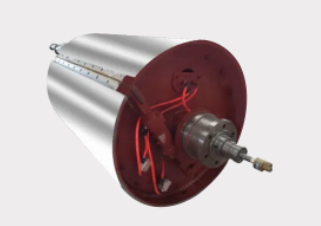
Rough machining techniques for chrome-plated rolls include shot peening, EDM rough machining and laser rough machining. Of these, laser roughening technology is relatively advanced, but its maturity in China is lower than that of traditional shot peening technology. Following shot peening treatment, the surface hardness and fatigue strength of the chrome-plated roll are enhanced, whilst the likelihood of slippage between the steel strip and the chrome-plated roll is effectively reduced, thereby preventing scratches on the steel strip.
Coated rolls and ordinary steel rolls are widely used in domestic cold rolling production lines; however, their precision and wear resistance are poor, frequently leading to downtime for roll replacement and disrupting normal production. Currently, some domestic steel mills have begun to utilise rough-chromium-plated rolls and have achieved good economic benefits. The process for rough-hard chromium plating of rolls is as follows:
1. First, the surface of the chrome-plated roll is induction hardened to a depth of 3–5 mm, bringing the surface hardness to HRC 45–55. The roller surface is then ground to achieve a surface roughness (Ra) of ≤0.8 μm, with no spiral marks or grinding vibration marks permitted. For rollers with high surface quality requirements, the surface must be ground to Ra < 0.2 μm. Additionally, the rollers must undergo dynamic balancing tests, and a small blind hole must be drilled at the roller end using the weight-removal method to ensure a balance quality grade higher than G16.
2. The surface of the chrome-plated roll is then roughened to increase its coefficient of friction, enabling it to adhere more closely to the strip during operation. Furthermore, due to the action of gases trapped in the pits on the roll surface, a protective gas film forms between the strip and the roll surface, thereby preventing the roll from scratching the strip. Currently, surface roughening techniques include shot peening, electrical discharge machining (EDM) roughening and laser roughening. Of these, laser roughening is a relatively advanced technology, but its maturity in China is lower than that of traditional shot peening. Shot peening treatment increases the surface hardness and fatigue strength of the roll, effectively reducing the likelihood of slippage between the strip and the roll, thereby preventing scratches on the strip.
3. Finally, the roller surface is electroplated with hard chrome. The coating thickness ranges from 0.05 to 0.15 mm (less than 0.20 mm), with a hardness of up to HV 900–1000. Prior to electroplating, the roll body must be degreased and cleaned, and the surface quality must be rigorously inspected. Defects such as porosity, cracks, rust and scratches are not permitted. After electroplating, the roll surface should be smooth and colourless, and the peaks should be polished.




