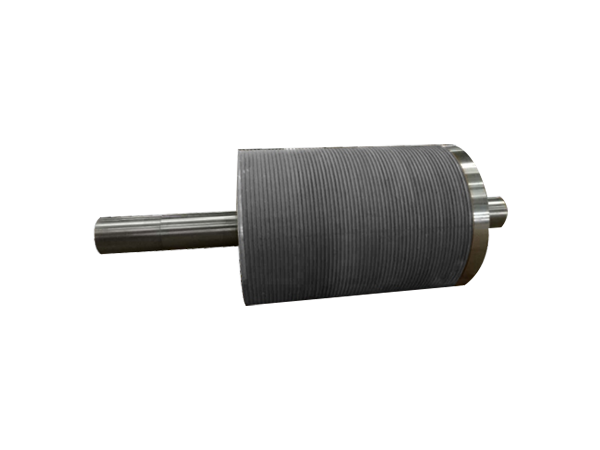
The company primarily manufactures a range of steel rollers suitable for use in the paper, metallurgy, leather, printing and dyeing, rubber and plastics, textile machinery, and food processing industries. We are capable of independently carrying out all key production processes, including cutting, riveting and welding, machining, and heat treatment.
Thanks to the company’s consistently excellent reputation within the industry, superior product quality, advanced manufacturing equipment and reliable delivery guarantees, we have secured a large base of long-term, stable clients and achieved a certain level of recognition within the sector. The company has now become a qualified supplier to leading domestic and international industry players such as Danieli, Andritz, Siemag, Valmet, Wuxi Baoke and Dalian Huarui Heavy Industry, and maintains strong cooperative relationships with them.
Product Introduction
Metallurgical rolls can be categorised by surface treatment into electroplated rolls, tungsten carbide rolls, quenched rolls and rubber-coated rolls. Electroplated rolls can be further subdivided into standard electroplated rolls and roughened electroplated rolls; by roll profile, they can be classified into medium-flat rolls and medium-high rolls.
Metallurgical Roll Manufacturing Process
Quenched Roll Manufacturing Process
Product Introduction
Technical Requirements
The roll body is forged, undergoes non-destructive testing followed by rough machining, and is subjected to medium-frequency surface hardening with a depth of 3–5 mm to enhance surface hardness. The surface hardness reaches HRC 50–62, and the roll body materials include 45#, 50#, 40Cr, 42CrMo, etc., with the material selected based on hardness requirements.
A new method has now been developed using large-diameter structural seamless steel tubes to manufacture forged rolls, with the process as follows:
Advantages
1. Through three rolling passes—primary, finishing and sizing—the rolling ratio can reach over 3;
2. Good uniformity of properties: during the rolling process, the steel tube undergoes uniform and continuous deformation in both the longitudinal and transverse directions, with forces acting uniformly;
3. No concerns regarding weld seams on the roller surface, and lower costs compared to forged rollers;
4. Suitable for large-diameter quenched rollers, with no restrictions on time or quantity.
Quenched Roller Process Flow




